The Fourth Prescription: The Gentle Wet Clean
The beginner’s final at-home treatment (before the machines)
If you’ve followed the first three prescriptions, your collection is already in a much better place. You know how to handle records properly, store them safely, and give them a quick dry clean before each play. For many new or well-kept records, that routine is enough to keep playback clean.
Wet cleaning vinyl records can be a useful next step when a dry carbon fibre brush can no longer remove fingerprints, haze or stubborn surface contamination.
Sooner or later, though, you’ll meet a record that looks fine until you tilt it towards the light. Then the fingerprints, faint haze, or stubborn grime appear – the sort of contamination a carbon fibre brush simply cannot lift. That is when a gentle wet clean becomes useful.
This fourth prescription is designed as the next step after routine dry care. It uses minimal moisture and simple tools, so you can deal with fingerprints, light film, and stubborn surface contamination at home without jumping straight into expensive machines or complicated chemistry.
When a carbon fibre brush isn’t enough
A carbon fibre brush is excellent for loose dust and static, which is why it works so well as a pre-play routine. What it does not handle well is oil, smudges, and residue that has settled to the groove walls – especially fingerprints or contamination that has been sitting there for a while.
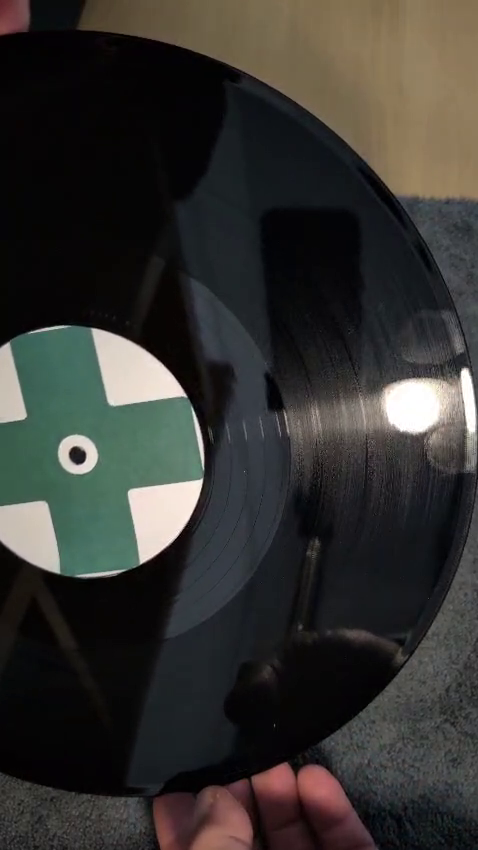
A wet clean is worth considering when crackle persists on a record that otherwise looks clean, when you can see fingerprints or cloudy patches under a lamp, or when you are dealing with a second-hand record whose history is unknown. A slightly sticky drag from surface contamination is another sign that dry brushing has reached its limit.
The aim here is not to scrub the record. It is to use a small, controlled amount of moisture to loosen contamination and lift it away rather than spread it around.
Why a little moisture helps
After a dry clean, the noise that remains often comes from contamination that is oily or more firmly embedded. Loose dust can be removed mechanically, but oils and films tend to hold particles in place and attract more grime. A lightly dampened microfibre cloth helps loosen that material and gives it somewhere to go – into the fibres of the cloth rather than further into the groove.
Control is the important part. In this beginner-friendly method, the cloth does the work and the fluid only assists it. The record should never be flooded.
Wet Cleaning Vinyl Records: The Gentle Method
Set up on a clean, stable surface with enough light to see the record clearly. Place the record on a clean microfiber towel reserved only for record cleaning.
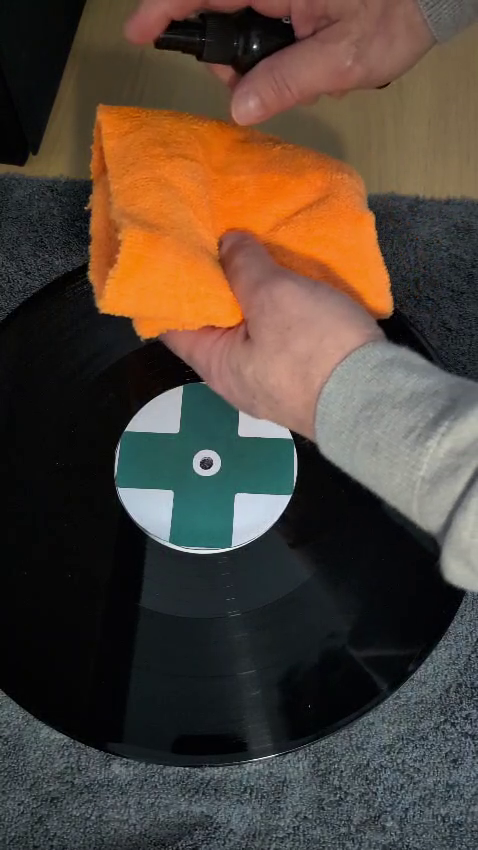
Start with a normal dry pass using the carbon fibre brush. This removes loose surface dust first, reducing the chance of dragging particles across the vinyl during the wet stage. Then prepare two dedicated microfibre cloths: one for the damp pass and one for drying. Paper-based materials and unsuitable cloths can leave fibres behind or mark the surface.
The beginner rule is simple: do not spray the record. Spray the cloth. A light mist is enough. The cloth should feel slightly damp, not wet, with no liquid pooling anywhere.
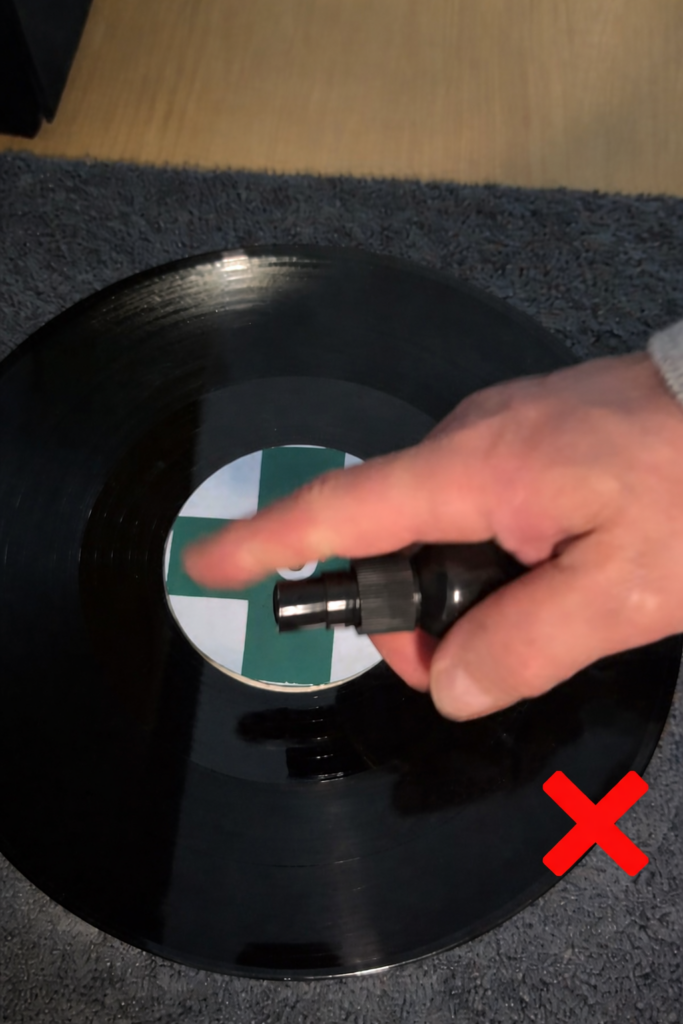
Use gentle contact and follow the direction of the grooves. You are not polishing a window; you are guiding the cloth along the same path the stylus follows. Move slowly and keep the pressure light. If a patch does not come away on the first pass, make another gentle pass rather than pressing harder.
More pressure is not better cleaning. It is simply a faster way to turn a cleaning job into possible damage.
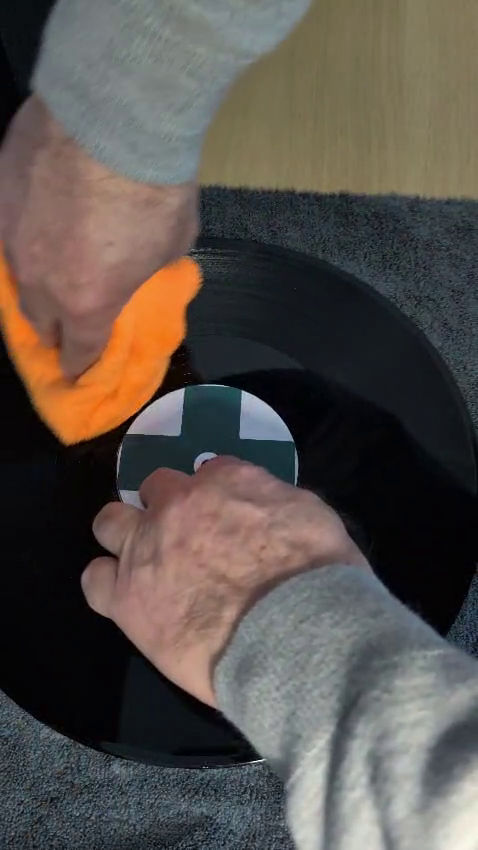
When the damp pass is finished, use the second, dry cloth in the same groove direction to lift the remaining moisture. Give the record a short rest so any trace moisture can evaporate naturally, then use your normal pre-play brush before putting the stylus down.
This is a light treatment, not a deep restoration. Used properly, though, it can be enough to take a record from ‘still a bit noisy’ to much cleaner playback.
Watch the full gentle wet-clean demo (real time): spray-on-cloth, light groove-direction passes, then a dry finish.
For a conservation-based reference, the Canadian Conservation Institute also describes gentle cloth-based cleaning for vinyl records, using a clean lint-free cloth followed by a second dry cloth.
Contraindications: wet-cleaning myths that cause harm
One of the easiest beginner mistakes is assuming that more fluid means more cleaning. It does not. Too much liquid can reach the label, pool on the surface, and leave residue behind. The same applies to the cloth: if it has been used elsewhere or washed with fabric softener, it can put contamination straight back onto the record. If you are not sure a cloth is clean, do not use it.
Another common mistake is scrubbing. If you feel you need to scrub, this method has probably reached its limit. Hard rubbing can increase the risk of micro-abrasion and may push debris further into the grooves. At that point, a deeper cleaning method makes more sense.
Be cautious with mystery wipes and pre-impregnated cleaning tissues as well. Some may work perfectly well, while others leave residues, and that is not always obvious until playback gets worse. If a record sounds dirtier after cleaning, residue or redistributed contamination is a more likely suspect than the record suddenly deciding to misbehave.
In the Vinyl Doctor’s clinic, if the treatment makes the patient worse, it is time to question the tool or the method.
The beginner wet-clean kit (around £20–£30)
You do not need a laboratory. You need a small kit that is kept clean and used consistently: two dedicated microfibre cloths, a small spray bottle, and a suitable record-cleaning fluid. Keep the cloths for records only and store them clean and dry. One is always the damp cloth; the other is always the drying cloth.
If you would rather avoid mixing your own cleaning chemistry, use a reputable record-cleaning fluid and follow the manufacturer’s instructions. For this cloth-based method, the aim is still controlled moisture rather than soaking the record. The same handling rule still applies for this method: put the fluid on the cloth, not directly on the record. At this level, careful technique matters more than an impressive-looking bottle.
It is a small and inexpensive kit, but consistency is what makes it useful.
When to escalate: deep cleaning and machines
This prescription covers a light wet clean that a beginner can carry out at home with minimal equipment. Some records need more. Second-hand finds with an unknown history, years of grime, or contamination deep in the grooves can be beyond what a damp cloth should be asked to fix.
That is where manual bath systems, vacuum record-cleaning machines, ultrasonic cleaning, and more structured multi-stage methods come in. They make sense when the simpler routine has reached its limit and when you are ready to justify the extra cost and effort.
If correct handling, good storage, daily dry care, and a gentle wet clean still do not improve a noisy record, the patient is asking for the next level of treatment.
For more serious contamination, professional preservation practice may involve more specialised cleaning methods, including vacuum-based cleaning rather than repeated hand wiping.
Discharge summary: the beginner’s complete treatment plan
If you try this method of wet cleaning vinyl records, let me know in the comments what changed. Did a fingerprinted record improve? Did the crackle settle down? And did you notice how much more useful patience was than extra pressure?
Next consultation: deep cleaning for second-hand records – manual bath systems, vacuum machines, and ultrasonic treatment.
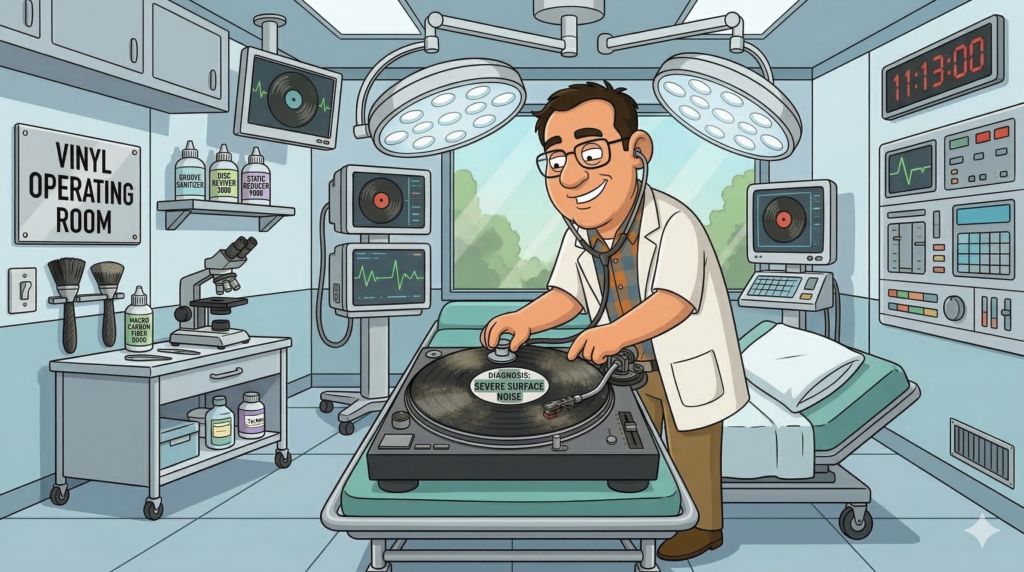
The Doctor is in.